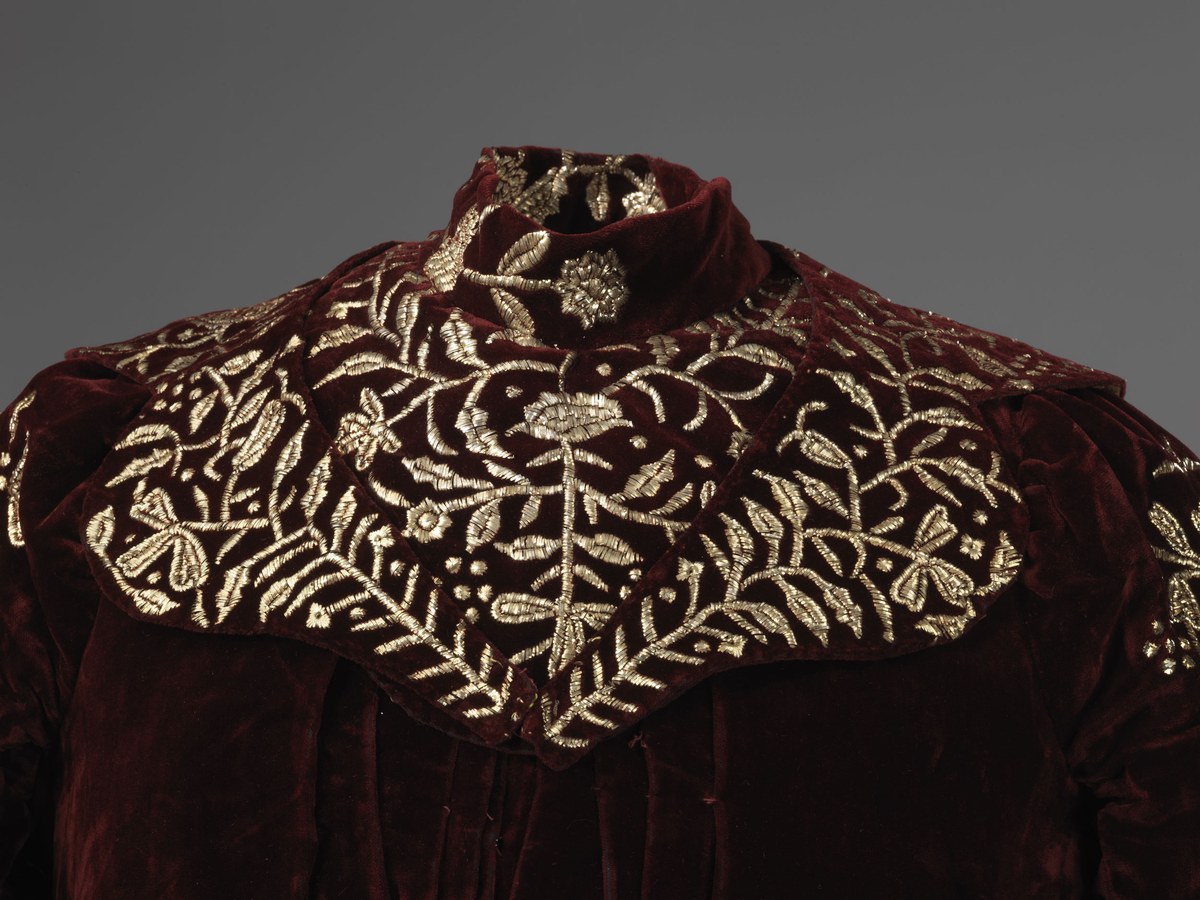
For a wedding
The families
behind the couple.
The places, people and crossings that brought two families to this day, told together in a wedding edition.
See two histories meetThe heirlooms
The whole family history, the life of someone you love, the traditions you share. For a wedding, a milestone birthday, or a gift to your parents or grandparents when the family gathers. Each edition brings research, writing and design to a subject that matters to you. Heirlooms are priced separately.
Open the family book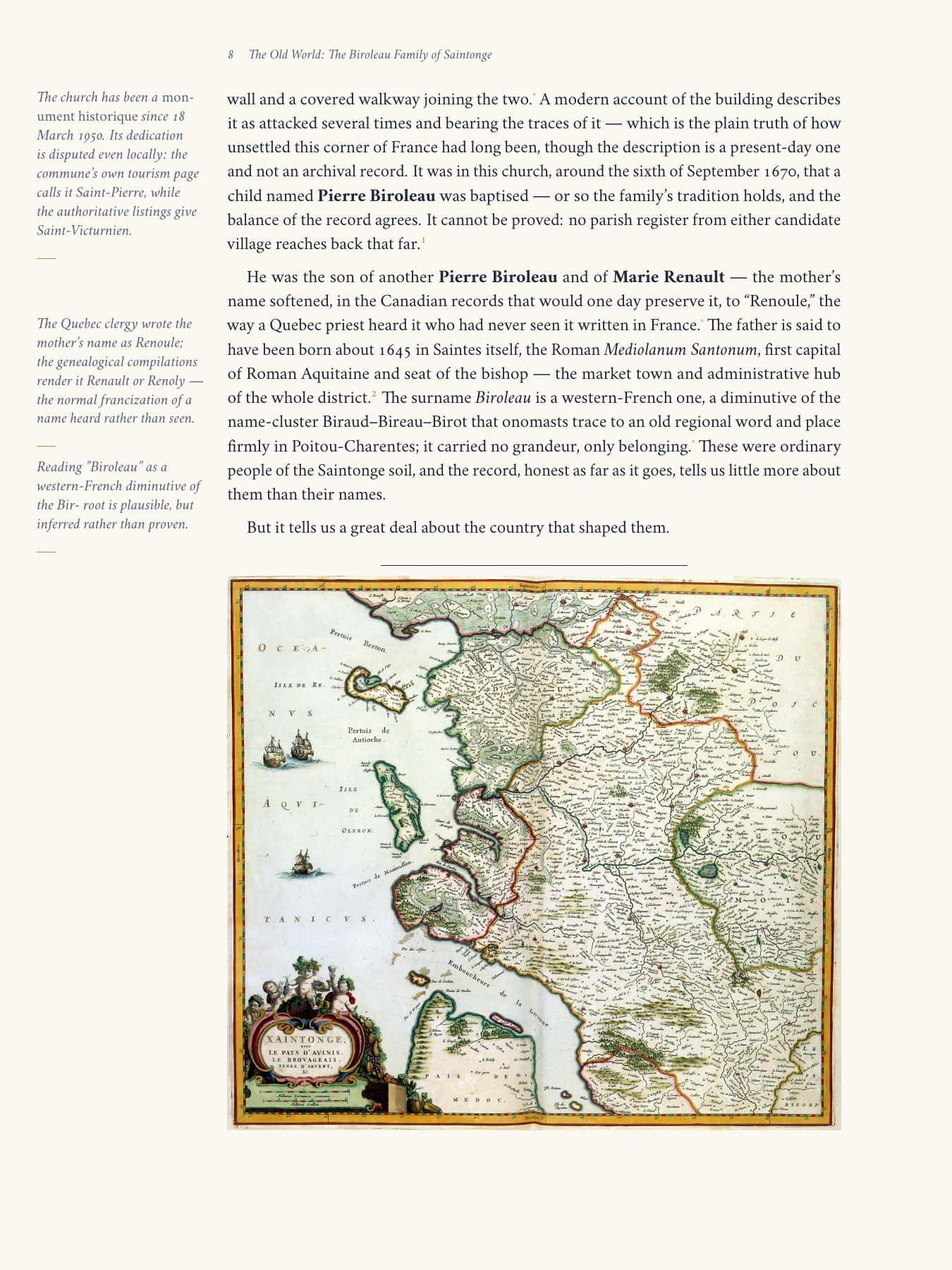
Made for an occasion
A wedding joins two histories. A birthday brings generations together. A family book gives everyone a place in the same story.
For a wedding
The places, people and crossings that brought two families to this day, told together in a wedding edition.
See two histories meet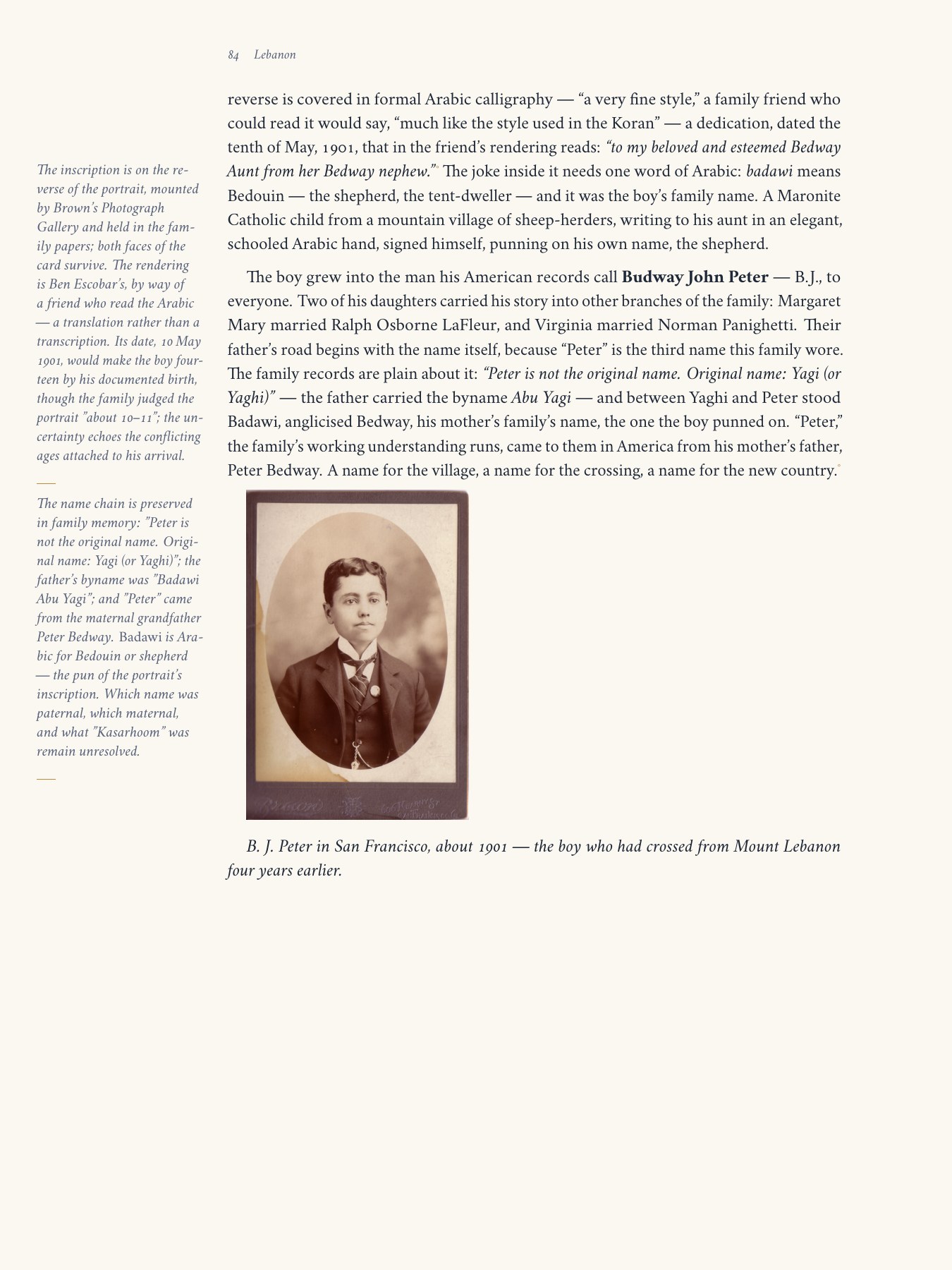
For a milestone birthday
For an eightieth birthday, the life before parenthood alongside the memories children and grandchildren can add.
Explore One Life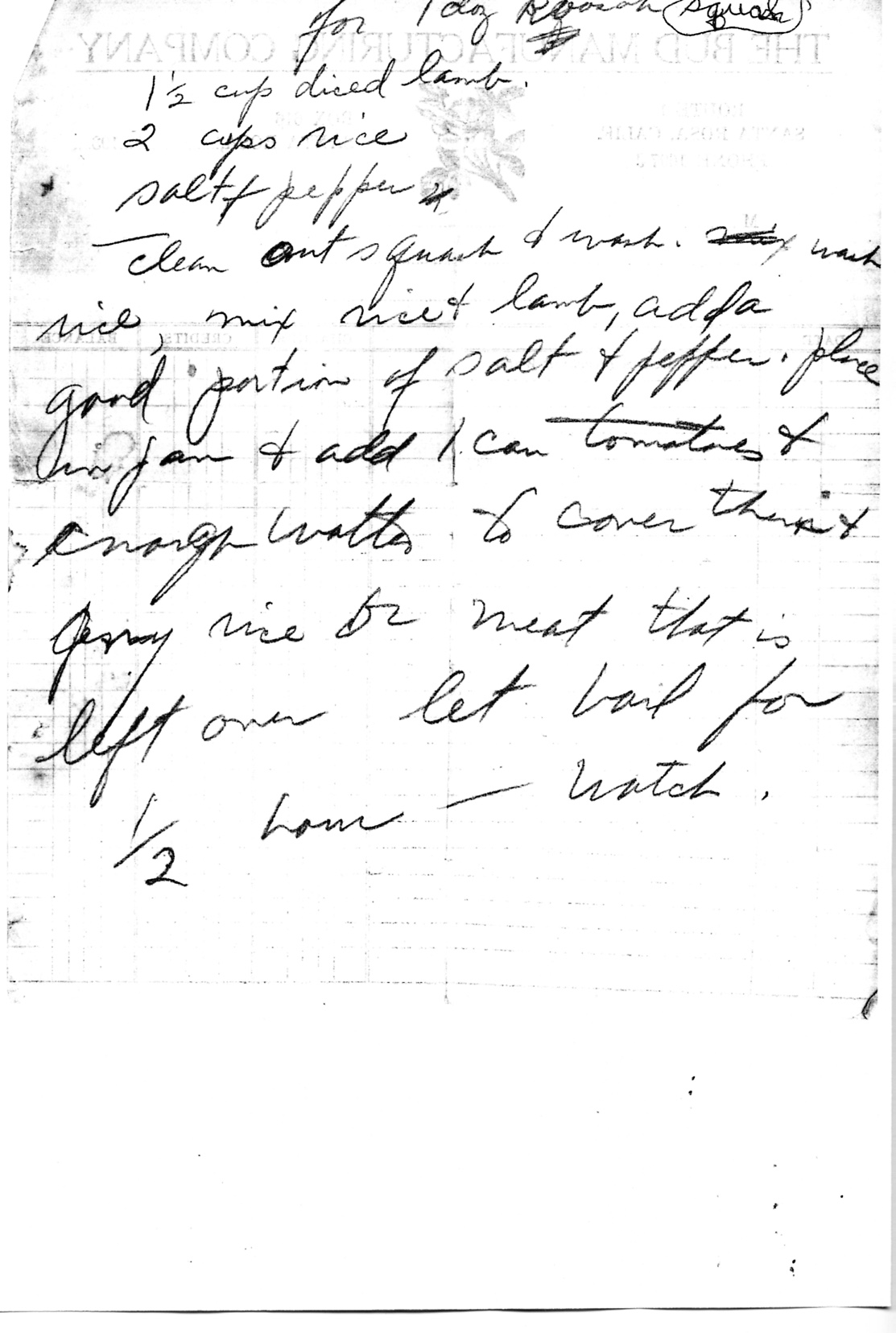
For a family gathering
At Passover, Hanukkah or Christmas, give your parents or grandparents the stories your family has gathered: familiar recipes, photographs from cousins, and memories from across the generations.
Open the recipe pagesThe Complete Chronicle
The stories can sit alongside photographs, letters, music and maps. The people you knew, and the lives that came before them, share the same pages.
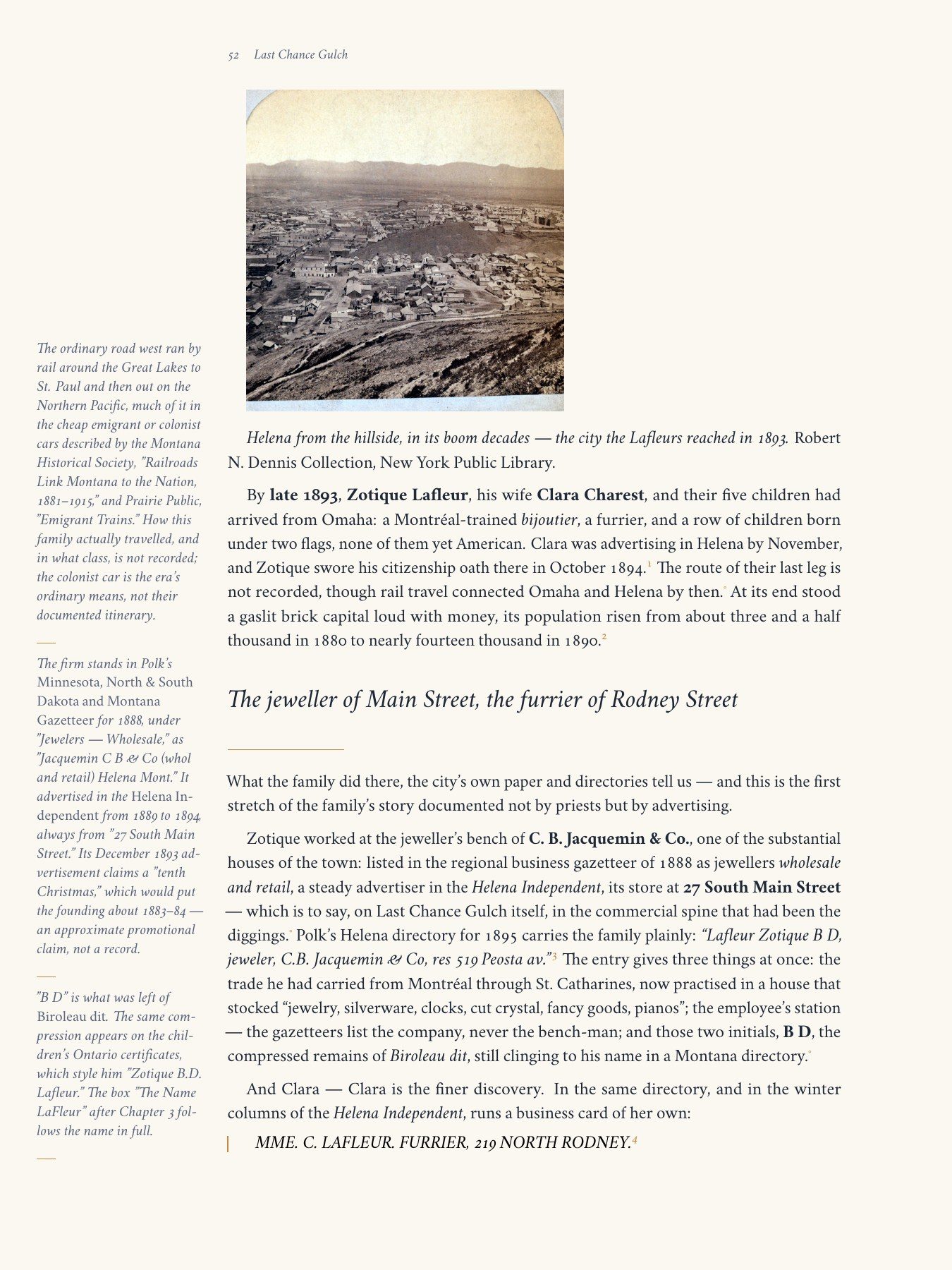
52 The ordinary road west ran by rail around the Great Lakes to St. Paul and then out on the Northern Pacific, much of it in the cheap emigrant or colonist cars described by the Montana Historical Society, ”Railroads Link Montana to the Nation, 1881–1915,” and Prairie Public, ”Emigrant Trains.” How this family actually traveled, and in what class, is not recorded; the colonist car is the era’s ordinary means, not their documented itinerary. The firm stands in Polk’s Minnesota, North & South Dakota and Montana Gazetteer for 1888, under ”Jewelers — Wholesale,” as ”Jacquemin C B & Co (whol and retail) Helena Mont.” It advertised in the Helena Independent from 1889 to 1894, always from ”27 South Main Street.” Its December 1893 advertisement claims a ”tenth Christmas,” which would put the founding about 1883–84 — an approximate promotional claim, not a record. ”B D” is what was left of Biroleau dit. The same compression appears on the children’s Ontario certificates, which style him ”Zotique B.D. Lafleur.” The box ”The Name LaFleur” after Chapter 3 follows the name in full. Last Chance Gulch Helena from the hillside, in its boom decades — the city the Lafleurs reached in 1893. Robert N. Dennis Collection, New York Public Library. By late 1893, Zotique Lafleur, his wife Clara Charest, and their five children had arrived from Omaha: a Montréal-trained bijoutier, a furrier, and a row of children born under two flags, none of them yet American. Clara was advertising in Helena by November, and Zotique swore his citizenship oath there in October 1894.1 The route of their last leg is not recorded, though rail travel connected Omaha and Helena by then.° At its end stood a gaslit brick capital loud with money, its population risen from about three and a half thousand in 1880 to nearly fourteen thousand in 1890.2 The jeweler of Main Street, the furrier of Rodney Street What the family did there, the city’s own paper and directories tell us — and this is the first stretch of the family’s story documented not by priests but by advertising. Zotique worked at the jeweler’s bench of C. B. Jacquemin & Co., one of the substantial houses of the town: listed in the regional business gazetteer of 1888 as jewelers wholesale and retail, a steady advertiser in the Helena Independent, its store at 27 South Main Street — which is to say, on Last Chance Gulch itself, in the commercial spine that had been the diggings.° Polk’s Helena directory for 1895 carries the family plainly: “Lafleur Zotique B D, jeweler, C.B. Jacquemin & Co, res 519 Peosta av.” 3 The entry gives three things at once: the trade he had carried from Montréal through St. Catharines, now practiced in a house that stocked “jewelry, silverware, clocks, cut crystal, fancy goods, pianos”; the employee’s station — the gazetteers list the company, never the bench-man; and those two initials, B D, the compressed remains of Biroleau dit, still clinging to his name in a Montana directory.° And Clara — Clara is the finer discovery. In the same directory, and in the winter columns of the Helena Independent, runs a business card of her own: MME. C. LAFLEUR. FURRIER, 219 NORTH RODNEY.4
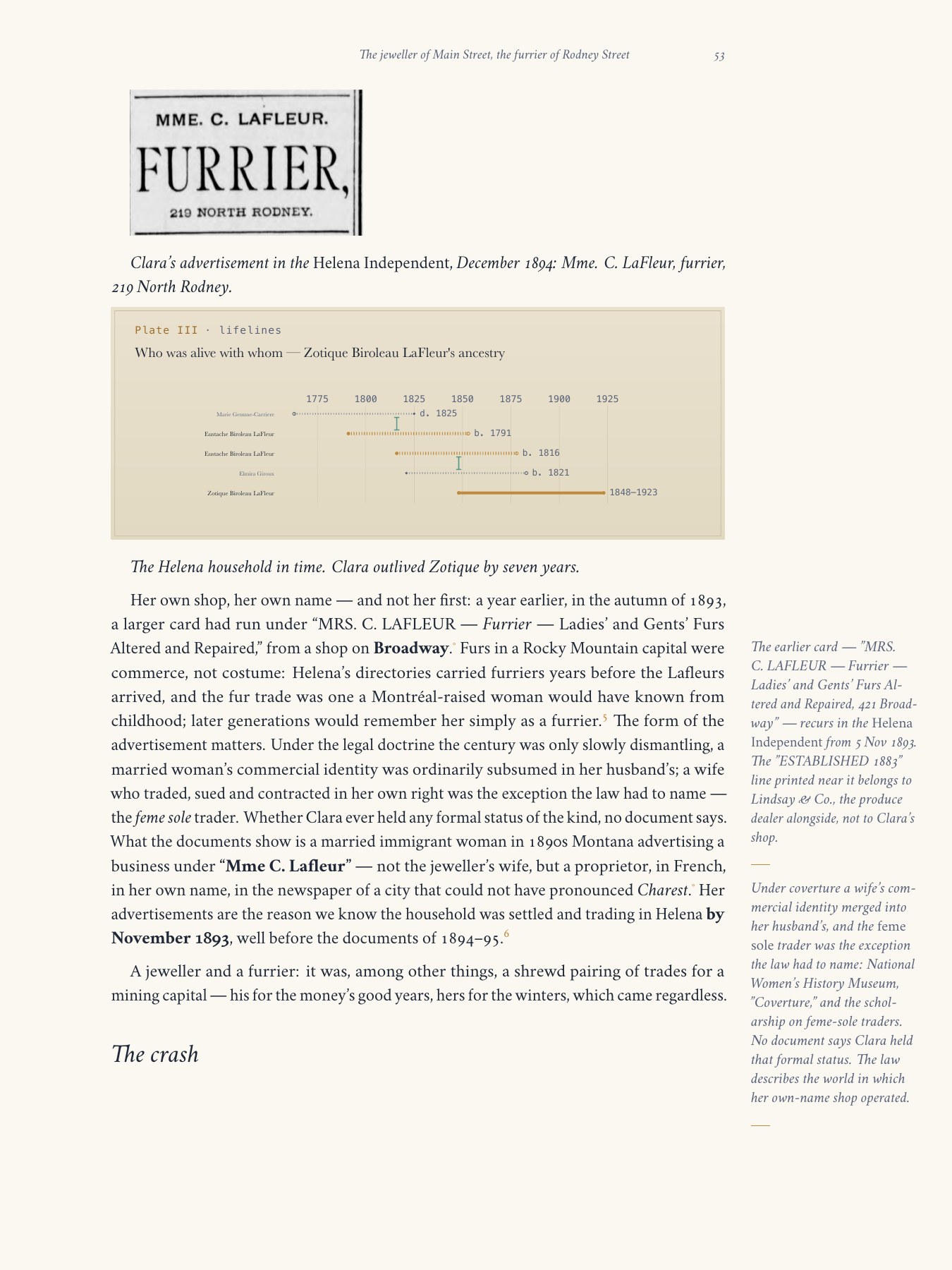
The jeweler of Main Street, the furrier of Rodney Street 53 Clara’s advertisement in the Helena Independent, December 1894: Mme. C. LaFleur, furrier, 219 North Rodney. Plate III · lifelines Who was alive with whom — Zotique Biroleau LaFleur's ancestry 1775 Marie Gemme-Carriere Eustache Biroleau LaFleur Eustache Biroleau LaFleur Elmira Giroux 1800 1825 1850 1875 1900 1925 d. 1825 b. 1791 b. 1816 b. 1821 Zotique Biroleau LaFleur 1848–1923 The Helena household in time. Clara outlived Zotique by seven years. Her own shop, her own name — and not her first: a year earlier, in the autumn of 1893, a larger card had run under “MRS. C. LAFLEUR — Furrier — Ladies’ and Gents’ Furs Altered and Repaired,” from a shop on Broadway.° Furs in a Rocky Mountain capital were commerce, not costume: Helena’s directories carried furriers years before the Lafleurs arrived, and the fur trade was one a Montréal-raised woman would have known from childhood; later generations would remember her simply as a furrier.5 The form of the advertisement matters. Under the legal doctrine the century was only slowly dismantling, a married woman’s commercial identity was ordinarily subsumed in her husband’s; a wife who traded, sued and contracted in her own right was the exception the law had to name — the feme sole trader. Whether Clara ever held any formal status of the kind, no document says. What the documents show is a married immigrant woman in 1890s Montana advertising a business under “Mme C. Lafleur” — not the jeweler’s wife, but a proprietor, in French, in her own name, in the newspaper of a city that could not have pronounced Charest.° Her advertisements are the reason we know the household was settled and trading in Helena by November 1893, well before the documents of 1894–95.6 A jeweler and a furrier: it was, among other things, a shrewd pairing of trades for a mining capital — his for the money’s good years, hers for the winters, which came regardless. The crash The earlier card — ”MRS. C. LAFLEUR — Furrier — Ladies’ and Gents’ Furs Altered and Repaired, 421 Broadway” — recurs in the Helena Independent from 5 Nov 1893. The ”ESTABLISHED 1883” line printed near it belongs to Lindsay & Co., the produce dealer alongside, not to Clara’s shop. Under coverture a wife’s commercial identity merged into her husband’s, and the feme sole trader was the exception the law had to name: National Women’s History Museum, ”Coverture,” and the scholarship on feme-sole traders. No document says Clara held that formal status. The law describes the world in which her own-name shop operated.
8 The church has been a monument historique since 18 March 1950. Its dedication is disputed even locally: the commune’s own tourism page calls it Saint-Pierre, while the authoritative listings give Saint-Victurnien. The Quebec clergy wrote the mother’s name as Renoule; the genealogical compilations render it Renault or Renoly — the normal francization of a name heard rather than seen. Reading ”Biroleau” as a western-French diminutive of the Bir- root is plausible, but inferred rather than proven. The Old World: The Biroleau Family of Saintonge wall and a covered walkway joining the two.° A modern account of the building describes it as attacked several times and bearing the traces of it — which is the plain truth of how unsettled this corner of France had long been, though the description is a present-day one and not an archival record. It was in this church, around the sixth of September 1670, that a child named Pierre Biroleau was baptised — or so the family’s tradition holds, and the balance of the record agrees. It cannot be proved: no parish register from either candidate village reaches back that far.1 He was the son of another Pierre Biroleau and of Marie Renault — the mother’s name softened, in the Canadian records that would one day preserve it, to “Renoule,” the way a Quebec priest heard it who had never seen it written in France.° The father is said to have been born about 1645 in Saintes itself, the Roman Mediolanum Santonum, first capital of Roman Aquitaine and seat of the bishop — the market town and administrative hub of the whole district.2 The surname Biroleau is a western-French one, a diminutive of the name-cluster Biraud–Bireau–Birot that onomasts trace to an old regional word and place firmly in Poitou-Charentes; it carried no grandeur, only belonging.° These were ordinary people of the Saintonge soil, and the record, honest as far as it goes, tells us little more about them than their names. But it tells us a great deal about the country that shaped them.
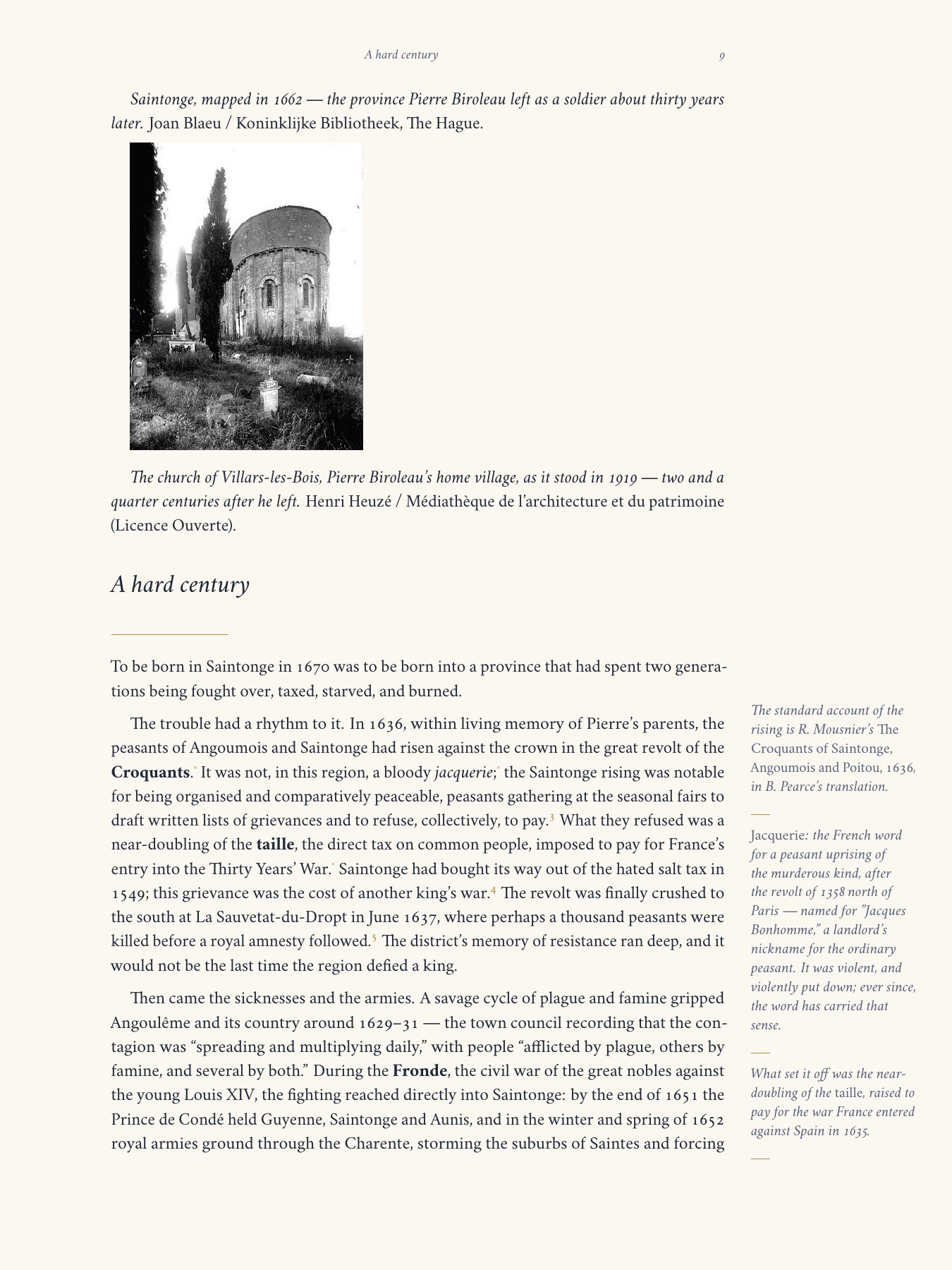
A hard century 9 Saintonge, mapped in 1662 — the province Pierre Biroleau left as a soldier about thirty years later. Joan Blaeu / Koninklijke Bibliotheek, The Hague. The church of Villars-les-Bois, Pierre Biroleau’s home village, as it stood in 1919 — two and a quarter centuries after he left. Henri Heuzé / Médiathèque de l’architecture et du patrimoine (License Ouverte). A hard century To be born in Saintonge in 1670 was to be born into a province that had spent two generations being fought over, taxed, starved, and burned. The trouble had a rhythm to it. In 1636, within living memory of Pierre’s parents, the peasants of Angoumois and Saintonge had risen against the crown in the great revolt of the Croquants.° It was not, in this region, a bloody jacquerie;° the Saintonge rising was notable for being organized and comparatively peaceable, peasants gathering at the seasonal fairs to draft written lists of grievances and to refuse, collectively, to pay.3 What they refused was a near-doubling of the taille, the direct tax on common people, imposed to pay for France’s entry into the Thirty Years’ War.° Saintonge had bought its way out of the hated salt tax in 1549; this grievance was the cost of another king’s war.4 The revolt was finally crushed to the south at La Sauvetat-du-Dropt in June 1637, where perhaps a thousand peasants were killed before a royal amnesty followed.5 The district’s memory of resistance ran deep, and it would not be the last time the region defied a king. Then came the sicknesses and the armies. A savage cycle of plague and famine gripped Angoulême and its country around 1629–31 — the town council recording that the contagion was “spreading and multiplying daily,” with people “afflicted by plague, others by famine, and several by both.” During the Fronde, the civil war of the great nobles against the young Louis XIV, the fighting reached directly into Saintonge: by the end of 1651 the Prince de Condé held Guyenne, Saintonge and Aunis, and in the winter and spring of 1652 royal armies ground through the Charente, storming the suburbs of Saintes and forcing The standard account of the rising is R. Mousnier’s The Croquants of Saintonge, Angoumois and Poitou, 1636, in B. Pearce’s translation. Jacquerie: the French word for a peasant uprising of the murderous kind, after the revolt of 1358 north of Paris — named for ”Jacques Bonhomme,” a landlord’s nickname for the ordinary peasant. It was violent, and violently put down; ever since, the word has carried that sense. What set it off was the neardoubling of the taille, raised to pay for the war France entered against Spain in 1635.
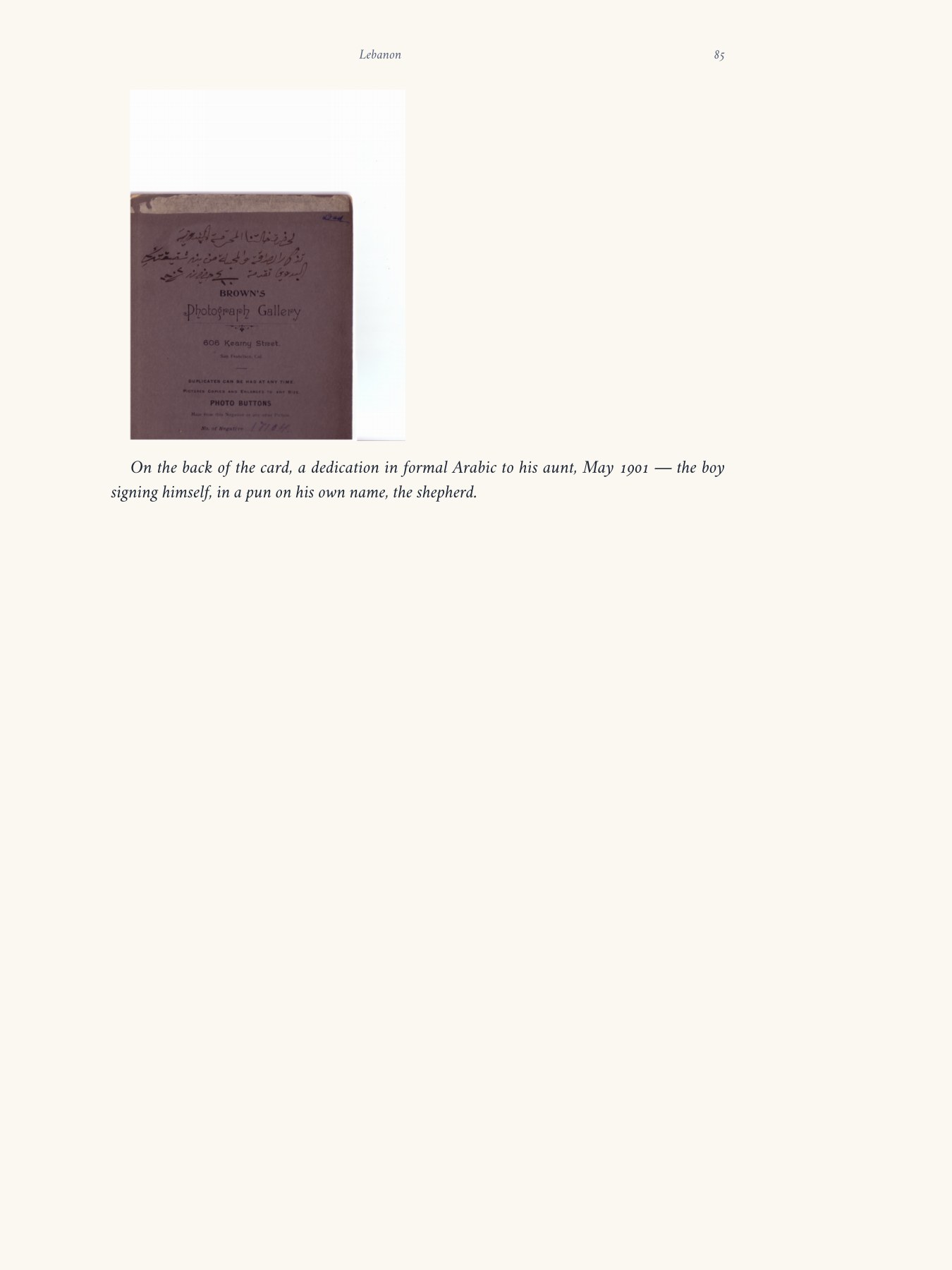
84 The inscription is on the reverse of the portrait, mounted by Brown’s Photograph Gallery and held in the family papers; both faces of the card survive. The rendering is Ben Escobar’s, by way of a friend who read the Arabic — a translation rather than a transcription. Its date, 10 May 1901, would make the boy fourteen by his documented birth, though the family judged the portrait ”about 10–11”; the uncertainty echoes the conflicting ages attached to his arrival. Lebanon reverse is covered in formal Arabic calligraphy — “a very fine style,” a family friend who could read it would say, “much like the style used in the Koran” — a dedication, dated the tenth of May, 1901, that in the friend’s rendering reads: “to my beloved and esteemed Bedway Aunt from her Bedway nephew.” ° The joke inside it needs one word of Arabic: badawi means Bedouin — the shepherd, the tent-dweller — and it was the boy’s family name. A Maronite Catholic child from a mountain village of sheep-herders, writing to his aunt in an elegant, schooled Arabic hand, signed himself, punning on his own name, the shepherd. The boy grew into the man his American records call Budway John Peter — B.J., to everyone. Two of his daughters carried his story into other branches of the family: Margaret Mary married Ralph Osborne LaFleur, and Virginia married Norman Panighetti. Their father’s road begins with the name itself, because “Peter” is the third name this family wore. The family records are plain about it: “Peter is not the original name. Original name: Yagi (or Yaghi)” — the father carried the byname Abu Yagi — and between Yaghi and Peter stood Badawi, anglicised Bedway, his mother’s family’s name, the one the boy punned on. “Peter,” the family’s working understanding runs, came to them in America from his mother’s father, Peter Bedway. A name for the village, a name for the crossing, a name for the new country.° The name chain is preserved in family memory: ”Peter is not the original name. Original name: Yagi (or Yaghi)”; the father’s byname was ”Badawi Abu Yagi”; and ”Peter” came from the maternal grandfather Peter Bedway. Badawi is Arabic for Bedouin or shepherd — the pun of the portrait’s inscription. Which name was paternal, which maternal, and what ”Kasarhoom” was remain unresolved. B. J. Peter in San Francisco, about 1901 — the boy who had crossed from Mount Lebanon four years earlier.
Lebanon 85 On the back of the card, a dedication in formal Arabic to his aunt, May 1901 — the boy signing himself, in a pun on his own name, the shepherd.
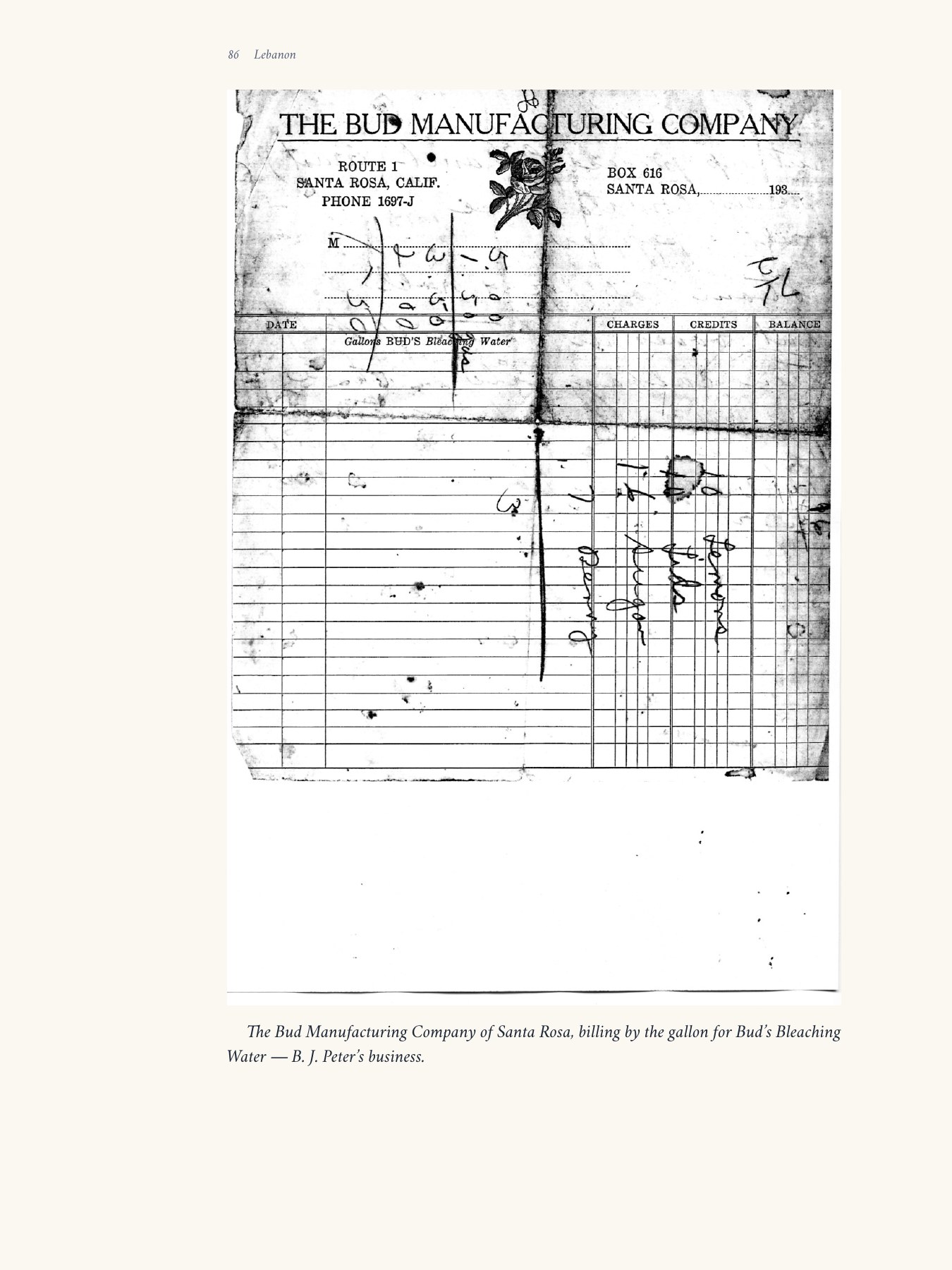
86 Lebanon The Bud Manufacturing Company of Santa Rosa, billing by the gallon for Bud’s Bleaching Water — B. J. Peter’s business.
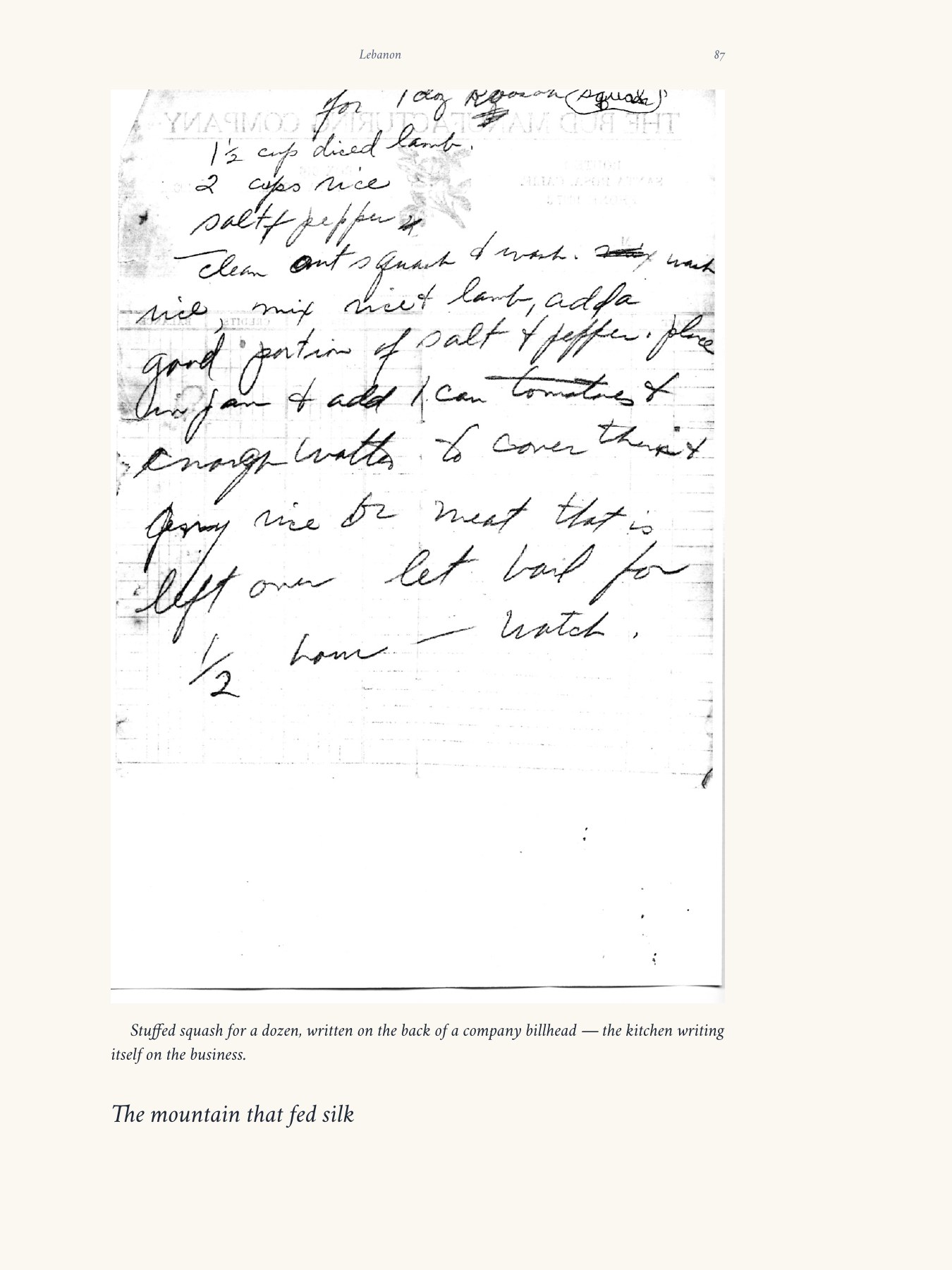
Lebanon 87 Stuffed squash for a dozen, written on the back of a company billhead — the kitchen writing itself on the business. The mountain that fed silk
The price of an heirloom
A commissioned family history can cost many thousands of dollars. We bring AI-led research, writing and design to what your family shares, so a book like these is within reach of many more families. Each heirloom is priced separately.
One history, many editions
A whole life for a birthday. The old village for someone returning there. A first family story for a grandchild. Each edition draws from your family’s history, with a different reader in mind.
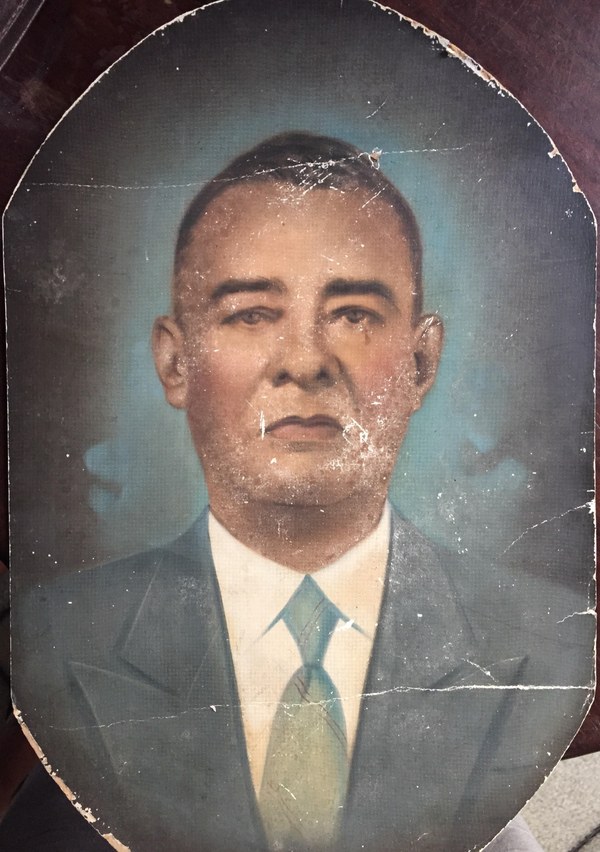
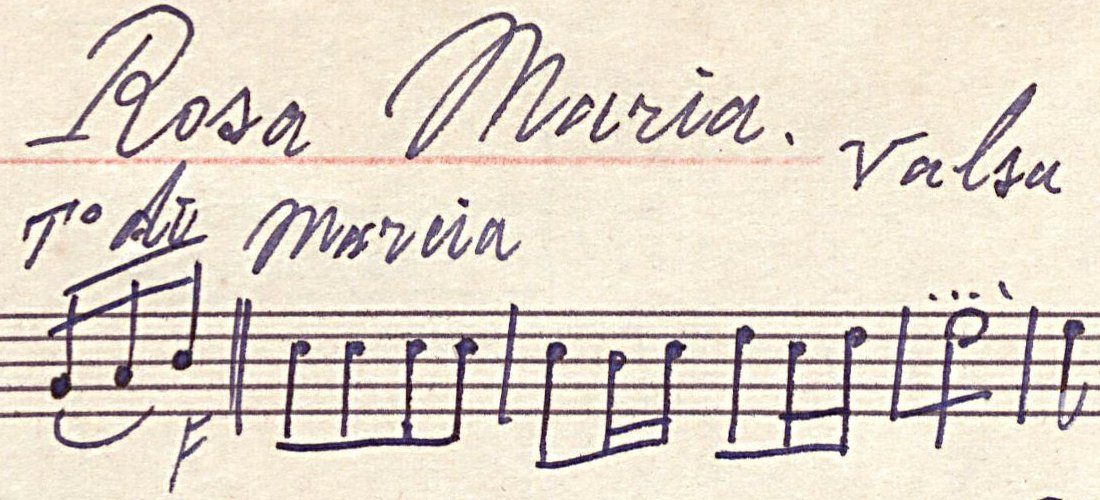
Grandpa Bernardino led the town band. Now his family can hear a little of “Rosa Maria”, the waltz that bears his name.
One Life
A portrait in words and pictures: their work, their world, the people around them. An edition devoted to one person.
Read the bandmaster’s storyThe Old Country
The village, the landscape, the world an ancestor knew. A place-centered edition brings the history home to somewhere you can find on a map.
Visit Saintonge in the bookFrom New France and Quebec, Ireland and Lebanon, Brazil and Italy: the branches meet across generations.
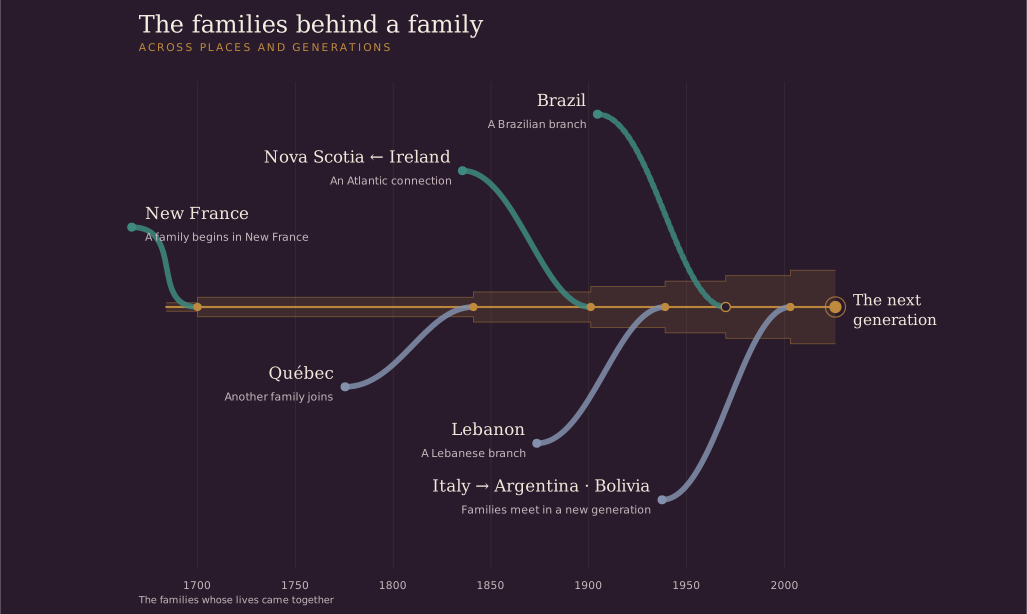
Where We Began
Follow a family from its earliest known generations into the branches that grew from them. A book about how you came to belong to one another.
Follow the family connections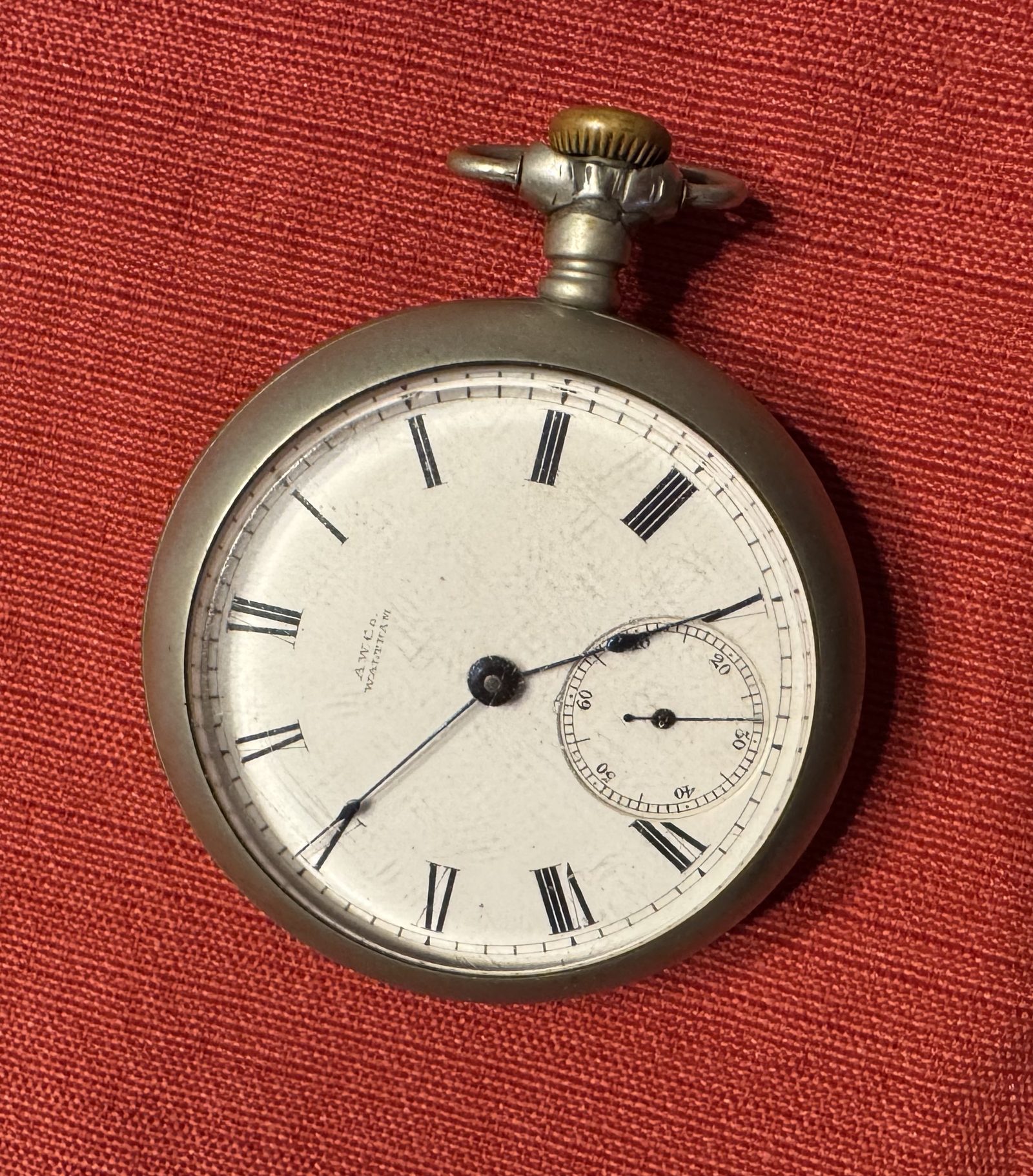
For his graduation, a young man received an old family watch from his father. It had belonged to three generations before him. Years later, he gave it to his nephew.
What would you pass on?For the Little Ones
The family’s stories told simply, with pictures and questions to share. Something to read together, and to grow up knowing.
The uncle sent a letter with the watch. He wrote down the names of the people who had owned it, all the way back to a jeweler in the family. “I love this old watch as I know you will,” he wrote.
One day, he hoped, his nephew would choose someone in the family to give it to.
Is there something in your home that belonged to someone in your family long ago? Who could tell you about it?
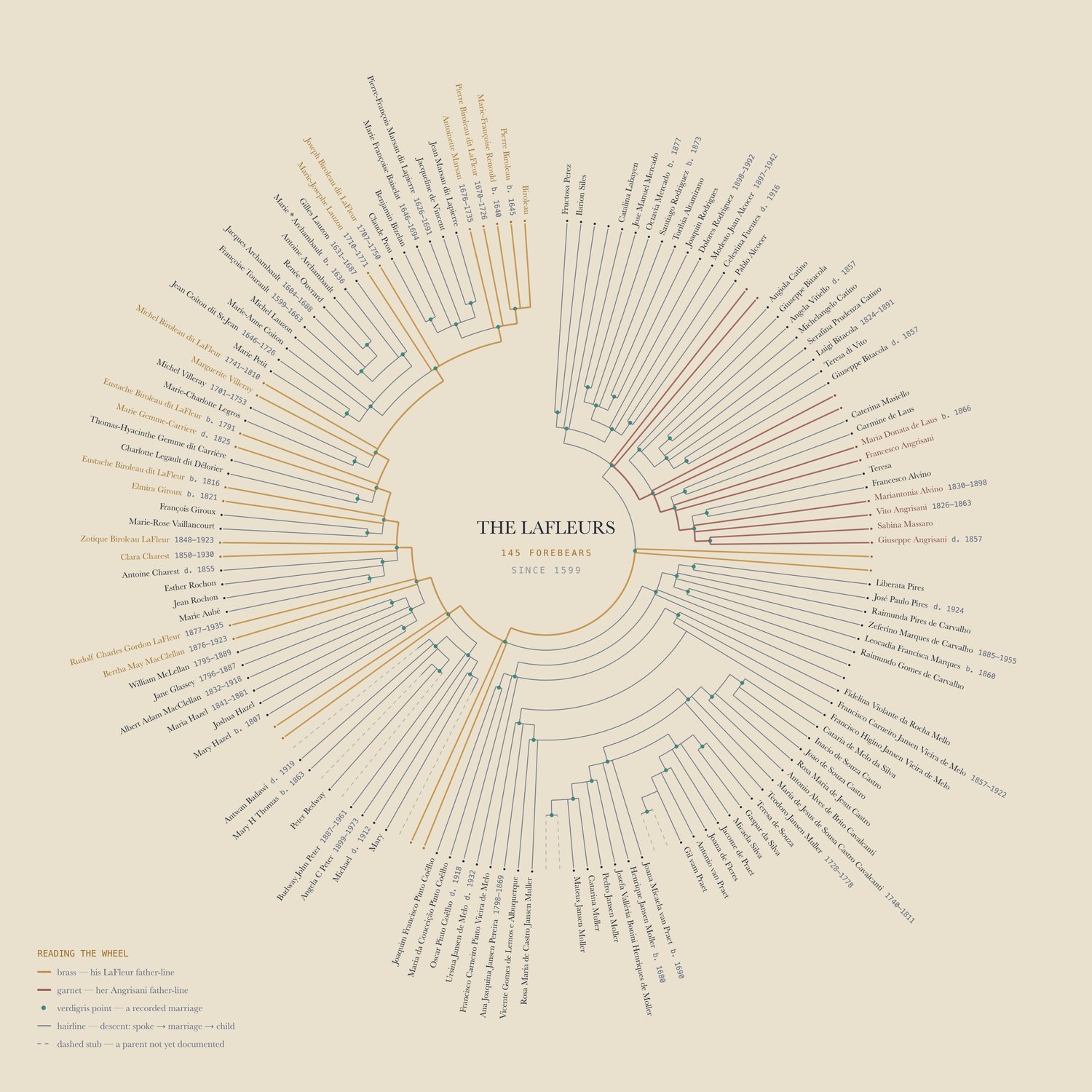
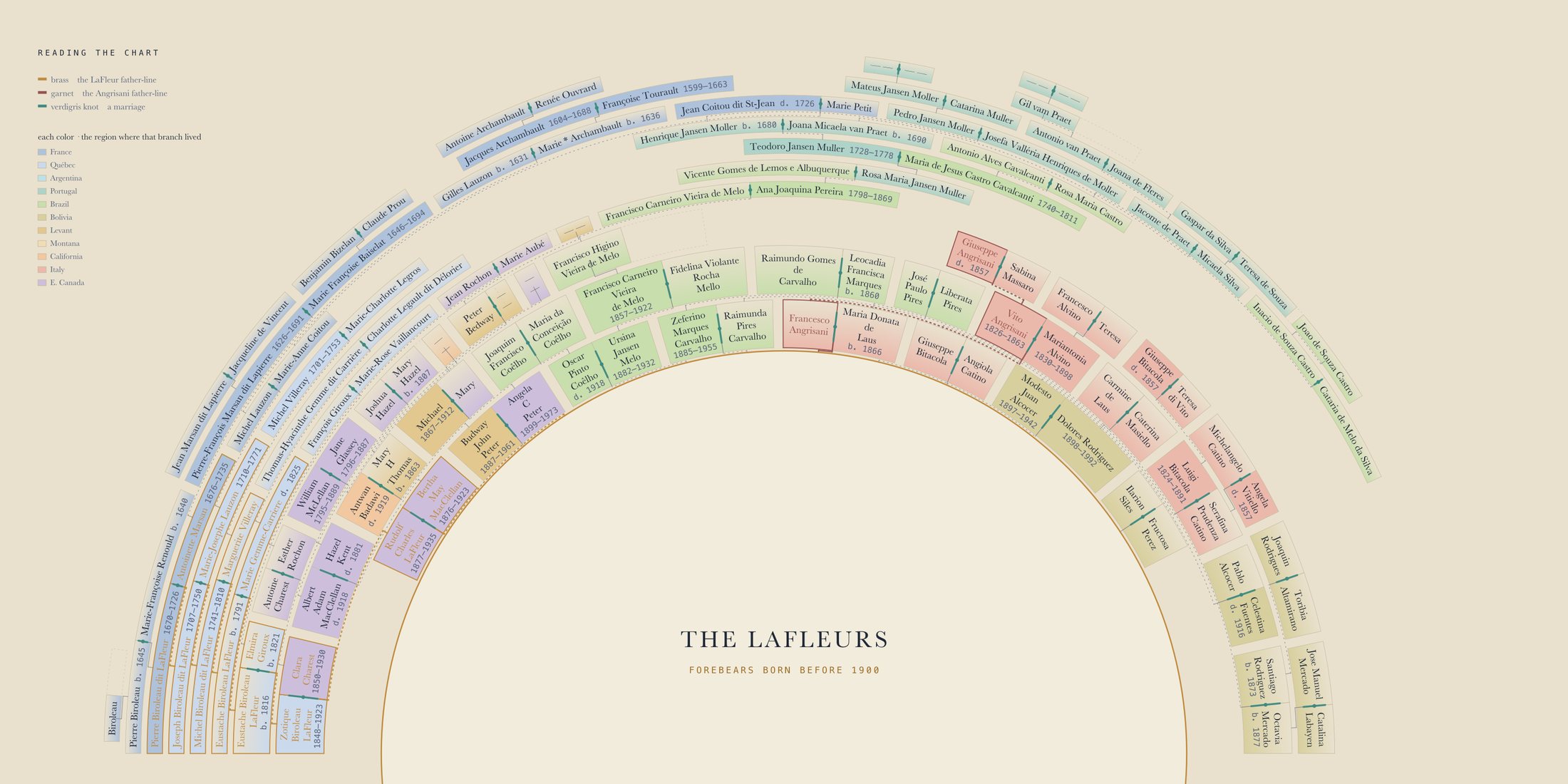
The family tree
A family tree to hang on the wall: every forebear on one circle, every branch colored by where it lived. Prints that invite you to stop, look closer and tell someone a story.
Vignettes
A short edition for a story you want someone to have. The watch and its keepers. A handwritten recipe. The music a family can hear again.
An object’s story
A pocket watch and a letter from 1988 carry the story of the family members who cared for it.
Meet the keepersA family recipe
Stuffed squash for a dozen, written on the back of a company billhead. A piece of family life to cook from and pass on.
Open the recipe pagesA family’s musicA musical keepsake
Grandpa Bernardino’s portrait, his years with the town band and a little of “Rosa Maria”, heard again in a new performance.
Read the musical storyThe making of an heirloom
Begin with the person, place or occasion you want to celebrate. An heirloom commission draws on the family’s history and includes the additional research, writing, design and physical production for that edition.
Its subject shapes the pages: a wedding may bring two family lines together; a birthday book may follow one life through photographs, letters and the memories of relatives.
How the editions are priced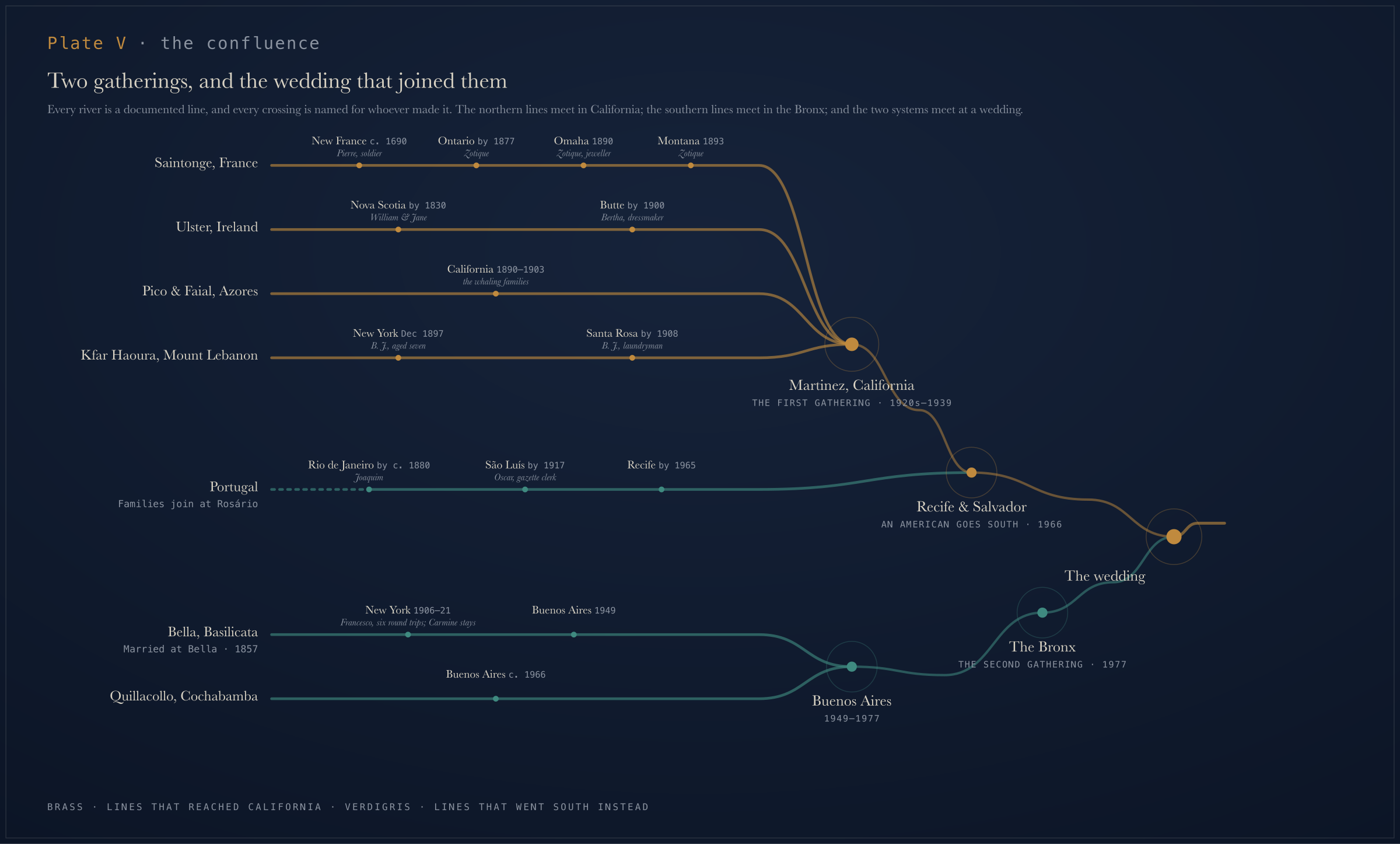
For a birthday, a wedding, a family gathering—or simply because these stories belong together.
Start your family’s legendry